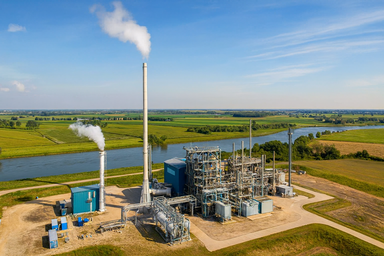
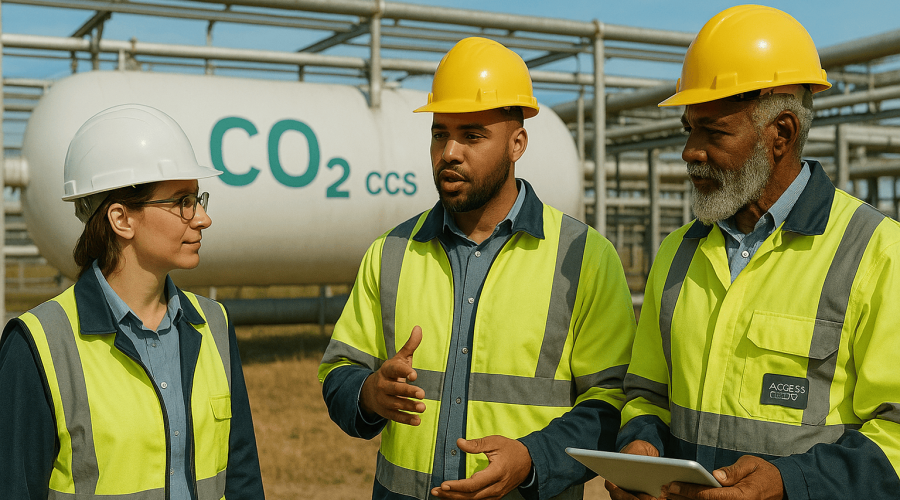
Geo Transition Energy drives the advancement of CCS as a practical and scalable pathway to reducing global CO₂ emissions. By capturing CO₂ directly from industrial processes, hydrogen facilities, power plants and other emission points, CCS provides a reliable solution for decarbonising sectors where electrification isn’t yet feasible.
Our team transforms depleted hydrocarbon reservoirs and deep saline aquifers into secure CO₂ storage formations through advanced subsurface analysis and engineering design. We also integrate Agentic AI systems that automate site screening, analyse geological risk, and optimise storage capacity predictions — accelerating decisions and reducing uncertainties.
Using industry-leading reservoir modelling, AI-supported forecasting and robust monitoring protocols, we ensure safe, long-term CO₂ containment aligned with regulatory standards, climate targets and ESG goals.

CCS prevents CO₂ from entering the atmosphere, delivering measurable climate-mitigation impact.
We specialise in repurposing depleted oil and gas reservoirs, storage wells and subsurface pipelines to reduce development time and capital costs.
Hard-to-abate industries — such as steel, cement, refining, ammonia and hydrogen — canoperate sustainably by integrating CCS.
Robust subsurface modelling, injection planning, risk management and integrity monitoring ensure CO₂ remains securely stored for centuries.
Our Agentic AI systems support automated plume prediction, rapid geological screening and real-time injection analysis, enabling safer and more informed decisions.
CCS integrates seamlessly with hydrogen, geothermal and subsurface energy systems — forming a stable multi-solution decarbonisation pathway.
Analyze geological basins, saline aquifers and depleted reservoirs using structural mapping, seismic interpretation and AI-assisted screening tools to identify optimal storage sites.
Create advanced 3D reservoir models enhanced with AI simulations to predict CO₂ plume movement, pressure changes, sealing efficiency and long-term stabilisation
Design capture systems, compression units and transport pathways (pipeline or alternative methods), ensuring flow efficiency, safety and operational continuity.
Plan injection wells and monitoring wells with detailed pressure and flow simulations.
AI-driven anomaly detection enhances integrity assessments and reduces risk of leakage.
Implement seismic, geochemical, pressure and remote-sensing monitoring technologies.
AI-supported verification frameworks automate reporting and help meet international CCS standards.